⏱️ Read time: 13 minutes · Last updated: October 2025 · Prices verified October 2025
You'll know you're close when the water changes colour. Not the murky green-blue of Patong Bay, but something deeper and stranger — the kind of turquoise that looks edited, even when it isn't. Then the limestone cliffs rise up out of nowhere, jagged and black against the morning sky, and Maya Bay appears between them like a shot from a movie. Which, of course, it is.
This is the Phi Phi Islands day trip from Patong — probably the single most popular excursion on this side of Thailand, and one of the most photographed stretches of coastline anywhere on the planet. It's also the one that travellers most often get wrong. Not because it's bad. It's genuinely spectacular. But because they book the wrong tour, at the wrong time, with the wrong expectations. And they come home with photos of 400 strangers in a bay instead of the serene paradise they had in mind.
We've done this trip more than a few times. Speedboat, big boat, private charter, in high season and low. Here's everything we've learned, and everything you need to know before you book.

The limestone cliffs around Phi Phi Leh — the scenery that makes the day trip worth the early start.
What Are the Phi Phi Islands, Exactly?
People talk about "Phi Phi" like it's one island. It's not. Phi Phi is an archipelago in the Andaman Sea, roughly 46 kilometres east of Patong. Two main islands matter for the day trip, and understanding the difference makes everything else clearer.
Koh Phi Phi Don is the larger, inhabited island. It has hotels, restaurants, a small village called Tonsai, and a busy pier. If you're staying overnight on Phi Phi — which many travellers do, and which we'll get to shortly — this is where you'll stay. It has two beautiful bays, Ao Tonsai and Ao Loh Dalum, connected by a narrow isthmus that makes the island look like a dumbbell from the air.
Koh Phi Phi Leh is the smaller, uninhabited island about 3 kilometres south of Phi Phi Don. This is the one everyone recognises. It's where Maya Bay sits, where The Beach was filmed, and where most of the day trip's photo opportunities happen. No one lives on Phi Phi Leh. Access to most of it is restricted, partly to protect the environment and partly because the crowds would be unmanageable otherwise.
There's a third, smaller island nearby called Bamboo Island that some day tours also include — flat, sandy, and much quieter than Maya Bay. More on that later.
How the Day Trip Works from Patong
Every day tour from Patong follows roughly the same rhythm. You get picked up at your hotel early — usually between 7:30 and 8:30 AM, though some premium tours leave later — and driven to a pier. Depending on the tour, that pier is either Patong Pier (about 10 minutes from Malin Plaza) or the bigger Rassada Pier in Phuket Town (about 40 minutes away). Speedboat tours usually leave from Patong. Big-boat tours usually leave from Rassada.
From there it's a 45-minute to 2-hour crossing depending on boat and sea conditions. You arrive at the islands around mid-morning, spend the next 4 to 5 hours hopping between viewpoints, snorkelling spots and beaches, eat a lunch (usually included in the tour price), and head back. You're typically back at your hotel between 5 and 6 PM.
It's a long day, and quite a packed one. But it's also one of those travel experiences that genuinely lives up to the hype — if you book the right tour and go in with the right mindset.
Which Type of Tour Should You Book?
There are three main options, and they're very different in price, comfort, and experience.
Speedboat Tour — the Standard Choice
This is what most people book. A speedboat carries between 20 and 40 passengers, takes 45–60 minutes each way, and visits four or five spots across the day. Tours depart Patong Pier or Chalong Pier depending on the operator.
Cost: 1,200–1,800 THB ($35–52 USD) per person, including hotel pickup, lunch, snorkelling gear and national park fees. The better operators use newer boats, cap the group at around 25 people, and time their stops to avoid the worst of the Maya Bay crush.
Speedboat is the right choice for most travellers. It's the fastest, and you spend more of your day actually at the islands rather than in transit.
Big-Boat Tour — the Slower, Cheaper Option
Larger boats that carry 80–150 passengers. Slower (2 hours each way), more stable in rough seas, and cheaper. These usually leave from Rassada Pier in Phuket Town, adding about 40 minutes of hotel transfer each way.
Cost: 900–1,200 THB ($26–35 USD) per person. Includes similar amenities to the speedboat tours but with more passengers.
Big boats make sense for anyone prone to seasickness, families with very small children, or travellers on the tightest budgets. But the extra transit time means less actual time at the islands.
Private Charter — the Splurge Option
You rent an entire speedboat for yourself and whoever is travelling with you. The itinerary is entirely up to you — you can skip Maya Bay if you've already seen it, spend an hour at Pileh Lagoon instead of the standard 20 minutes, or stop at places no tour group ever visits.
Cost: 8,000–15,000 THB ($230–430 USD) for the whole boat. Split between four people, this works out to roughly what a good group tour costs per person — but with complete flexibility and no crowds from your own boat.
This is genuinely worth considering if you're travelling as a group of four or more. The private charter experience is on another level, and you'll see more of the islands in a way that no shared tour can match.
💡 Insider tip: Whatever tour you book, ask directly: "How many people on the boat?" A "small group tour" that actually carries 40 people is not a small group tour. Genuine small group tours cap at 20–25. Some premium operators cap at 12. Pay the extra 200–300 THB for a smaller boat — it transforms the day.
What You'll Actually See on the Day Trip
Maya Bay — the Famous One
You know the one. The Beach. Leonardo DiCaprio. That shot of a pristine bay enclosed by 100-metre limestone cliffs, with sand so white it hurts to look at. Maya Bay is the main reason most people book this trip.
Here's the honest reality in 2025: Maya Bay is beautiful, but it is also crowded, restricted, and often visited at exactly the same time by every other tour boat on the water. Swimming is banned inside the bay. Boats anchor offshore and you wade in. The beach itself is roped off to protect the coral. You'll get 20–30 minutes on land, which is enough time for photos and a walk along the back of the beach, but not the serene experience the movie promised.
None of this means don't go. It means adjust your expectations. Maya Bay is worth seeing for what it is — one of the most striking natural formations you'll ever stand in front of. It's just not the empty paradise it once was.
Pileh Lagoon — the Real Star
Ask anyone who's done the trip and they'll tell you: Pileh Lagoon is the highlight, not Maya Bay. It's a perfectly enclosed lagoon surrounded by vertical cliffs on all sides, with water so clear you can see the bottom 5 metres down. Most tours stop here for swimming and snorkelling, usually for 30–45 minutes.
If you can, jump off the back of the boat and swim in the middle. The water is warm, silky, and unlike anything else you'll experience in Thailand. This is the moment most people remember most fondly from the whole trip.
Viking Cave — a Quick Pass-By
A limestone cave on Phi Phi Leh with ancient paintings on the walls. Tours usually slow down or stop briefly so you can see it from the boat, but you don't typically go inside. Worth a photo. Not the reason you're here.
Monkey Beach — Optional and Skittish
A small stretch of beach on Phi Phi Don where wild macaques sometimes come down to the sand. Whether you see them depends entirely on the day. If you do, they're wild animals and should be treated as such — do not feed them, do not try to touch them, do not leave your belongings unattended. Most tours don't actually stop here anymore because of bad tourist behaviour in the past.
Snorkelling Spots
Depending on your tour, you'll stop at one or two snorkelling spots around Phi Phi. Water clarity is usually excellent outside of monsoon season. You'll see tropical fish, hard and soft corals, sea urchins, and occasionally small reef sharks if you're lucky. Nothing comparable to the Similan Islands, but a genuinely enjoyable hour in the water.
Bamboo Island (on some tours only)
A small flat island northeast of Phi Phi Don. White sand, shallow clear water, and fewer crowds than Maya Bay. If you can find a tour that includes Bamboo Island, take it — this is often the best beach stop of the whole day.
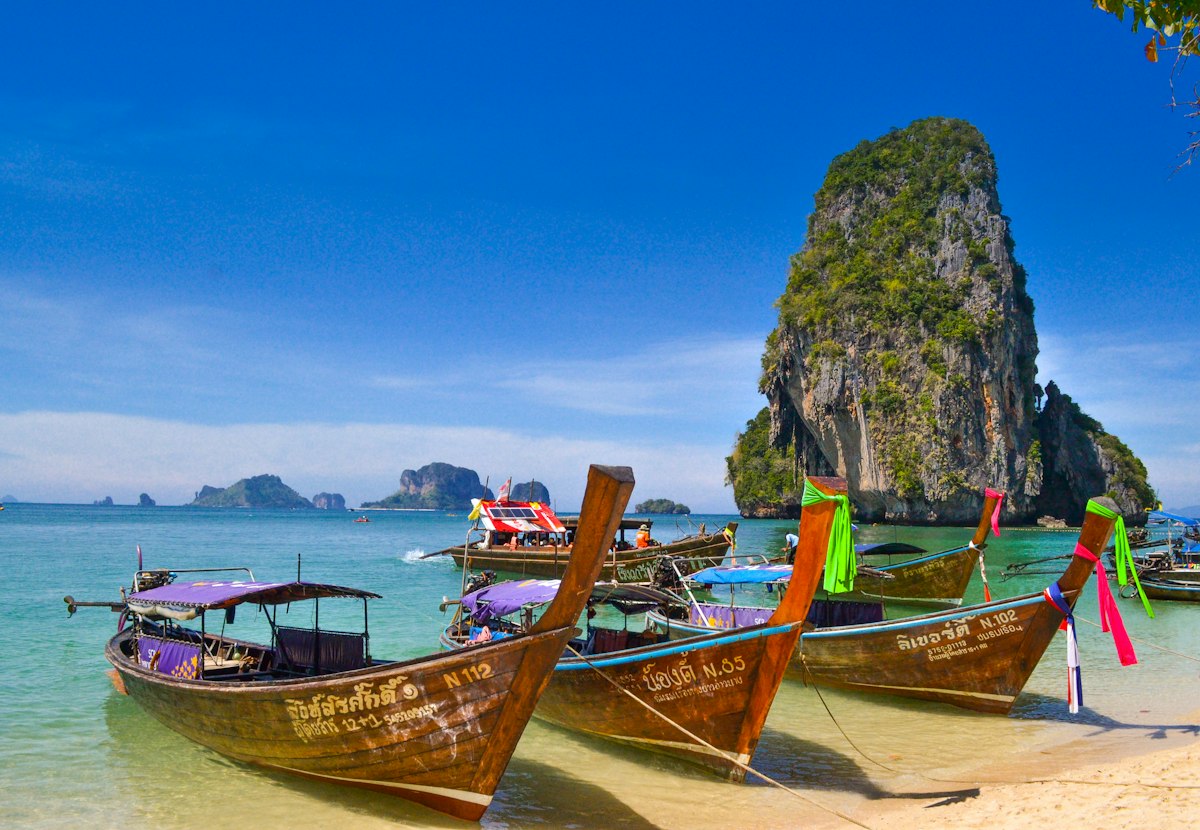
Longtail boats, turquoise water, limestone cliffs — the Phi Phi scenery lives up to the photos.
When to Go — Timing Matters More Than You Think
Phi Phi is a year-round destination, but the experience changes dramatically depending on when you visit.
High season (November–February): Best weather, calmest seas, clearest water. Also the busiest period, with every tour running at full capacity. If you're visiting now, book a small-group tour and go on a weekday.
Shoulder season (March–May, October): Our favourite window. Weather is still excellent, water is clear, and the crowds thin out meaningfully. May can bring occasional afternoon rain but rarely disrupts the morning tours.
Low season (June–September): Monsoon season. Some days the boats simply can't go out. Water visibility drops, tours get cancelled or shortened, and Maya Bay sometimes closes temporarily for environmental reasons. If you're visiting in low season, book a tour with a flexible cancellation policy and go with low expectations. On the good days, low season is actually superb — quiet, atmospheric, and much cheaper.
Whatever time of year you visit, aim for a tour that leaves early (7–8 AM pickup). The earlier you arrive at the islands, the fewer crowds you'll encounter. By 11 AM, every tour boat has arrived. By 10 AM, you can still find quiet moments.
How to Book — Where and What to Watch For
You have three main ways to book a Phi Phi day trip from Patong.
Through your hotel. The most convenient option. Your hotel concierge will book a reputable operator, usually at prices comparable to online. Useful if you want someone to call if something goes wrong.
Online in advance. Sites like Trip.com sell Phi Phi day tours with confirmed departures, English-language reviews, and often better prices than hotel desks. Booking ahead also guarantees your spot in high season, when good tours sell out days in advance.
Walk-up at a tour desk in Patong. Cheapest option but riskiest. Prices fluctuate and quality varies wildly. Only worth doing if you're in low season and can negotiate hard.
🎯 Insider tip: Whatever the tour desk tells you, always check the actual operator's reviews on TripAdvisor before handing over money. Some Patong tour agents sell "Phi Phi tours" that are really just ferry tickets with no guide, no snorkelling, and no Maya Bay stop. These typically cost 900 THB and are a complete waste of a day.
What to Bring — and What to Leave Behind
Pack light. You'll be on a boat in the sun for most of the day, and anything you bring needs to survive salt water and sunscreen.
Bring: Reef-safe sunscreen (regular sunscreen damages coral and many operators now insist on reef-safe formulas), a light towel, a dry bag for your phone and wallet, flip-flops or water shoes, a hat, sunglasses, and a waterproof phone case if you plan to take photos in the water. Some tours provide snorkelling gear, but bringing your own mask is often better quality if you have one.
Leave behind: Your passport. Leave it in your hotel safe. There is zero reason to carry it on a boat trip and a real risk of losing it. Also leave expensive jewellery, large amounts of cash, and anything you'd be devastated to lose. Bring only what you need for the day — around 1,000 THB is more than enough.
What NOT to do: Do not wear sunscreen that isn't reef-safe. Do not touch or stand on coral. Do not feed the fish or the monkeys. Do not take shells, sand, or coral as souvenirs — it's illegal and contributes directly to reef damage. Do not attempt to swim in areas where the boat crew tells you not to.
Costs — A Realistic Daily Budget
Speedboat group tour: 1,200–1,800 THB ($35–52 USD) per person, including transfer, lunch, snorkelling gear, and national park fees.
Big-boat tour: 900–1,200 THB ($26–35 USD).
Private charter: 8,000–15,000 THB ($230–430 USD) for the whole boat.
On top of the tour cost, expect to spend:
Tips for the crew: 100–200 THB ($3–6) — not required but appreciated and standard.
Extra drinks and snacks: 100–300 THB ($3–9) on Phi Phi Don or at the tour lunch stop.
Rental of underwater camera or GoPro: 500–1,000 THB if you want one.
Extra drinks and snacks on Phi Phi Don: 100–300 THB ($3–9).
Underwater camera rental: 500–1,000 THB if you didn't bring one.
Realistic total for the day: 1,500–2,500 THB ($43–72 USD) per person on a standard speedboat tour.
Should You Stay Overnight Instead?
Honest answer: yes, if you can. A day trip gives you a taste of Phi Phi. Staying one or two nights gives you the actual experience.
When the day-trippers leave at 4 PM, Phi Phi Don transforms. The beaches empty out. The restaurants get quiet and local. The sunset from the viewpoint above Tonsai Village is genuinely one of the most beautiful things you can see in Thailand. And the following morning, before the first tour boats arrive around 10 AM, you have the island almost entirely to yourself.
Staying overnight costs more — accommodation on Phi Phi Don is generally more expensive than Patong, and you'll need to book a hotel on the island separately. But the difference in experience is enormous. If your trip has the flexibility, spend at least one night on Phi Phi and do the day-trippers' spots early in the morning before everyone else arrives.
For accommodation on Phi Phi, or to compare the cost of an overnight stay versus basing yourself in Patong, check current rates on Agoda — they cover both Phi Phi Don and Patong hotels in the same search.
What to Eat and Drink on the Trip
Most tours include a simple buffet lunch on Phi Phi Don — usually rice, curry, a vegetable dish, and a fruit plate. Nothing spectacular but sufficient and safe. Vegetarian options are usually available but worth confirming with the operator when you book.
If you get free time on Phi Phi Don, avoid the restaurants immediately at the pier — they're overpriced and mediocre. Walk 5 minutes inland to Tonsai Village where the food is better and cheaper. There are also several small coffee shops and bakeries worth stopping at if you have time.
Bring a refillable water bottle. Most tours provide bottled water but it's worth having your own for the boat journey.
The Bottom Line on Phi Phi from Patong
The Phi Phi Islands day trip from Patong is genuinely one of the best things you can do from Phuket, and it deserves its reputation. The scenery is on another level, the water is extraordinary, and even the most jaded traveller tends to come back a little awestruck. It's also a very popular trip, which means it's crowded — especially around Maya Bay.
Book the right tour, go early, expect crowds, and adjust your expectations around Maya Bay in particular. If you can stay overnight, do. And when you're back in Patong that evening, with salt still in your hair, do what everyone else does: walk over to Malin Plaza for grilled prawns and a cold beer. It's the perfect end to a long day on the water.
🏨 Staying in Patong? Pick a hotel within walking distance of Malin Plaza and you can do the Phi Phi day trip without any pre-dawn taxi hassle — most tours pick up from any central Patong hotel. Compare current rates on Agoda or Trip.com.